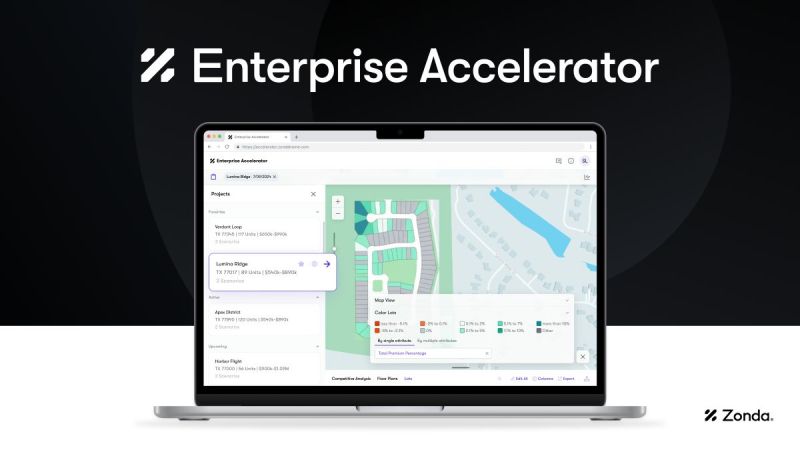
For decades, pricing a new community meant hours of manual work—spreadsheets, pricing studies, and lot-by-lot analysis that were as time-consuming as they were complex. A new tool aims to change that.
Today, Zonda launched Accelerator, an all-in-one revenue-modeling intelligence solution designed to help builders price with greater speed, confidence, and precision. Built as an enhancement to Enterprise, Zonda’s flagship data platform, Accelerator streamlines sales and marketing workflows by allowing teams to analyze a project all the way down to the individual lot.
For many builders, it’s likely to be a welcome shift.
“I’ve been working with builders and developers for more than 30 years, and for most of that time this process was completely manual,” says Peter Dennehy, principal in the home building sector for Zonda Advisory. “Pricing studies, lot by lot—it was painstaking work. Accelerator starts doing that heavy lifting for us.”
From a Manual Process to Fast, Data-Driven Pricing
Powered by AI and machine learning layered on top of Zonda’s proprietary data, Accelerator enables builders to model different customized inventory and revenue scenarios using current market intelligence. The goal: Help teams execute their unique business strategies more efficiently.
“This isn’t just an automation tool,” Dennehy says. “It’s an advancement in data science and pricing analytics that’s changing the way the industry approaches home pricing.”
Accelerator draws from millions of public data points across Zonda’s in-house intelligence, new-home construction data, listing data, and deed and closing records to feed Zonda’s proprietary competitive market analysis model, which can be refined by the user to align with their unique market view. Within the Accelerator platform, users can build project-specific scenarios and generate what the tool calls an Accelerator Price—a price backed by Zonda’s competitive market analysis model. The user can further customize the model by adding custom variables and inputs reflecting their own market strategy and competitive advantage.
Not One-Size-Fits-All
Customization is one of Accelerator’s biggest strengths.
“When you open the tool, base prices by floor plan based on the CMA model are provided, and lot premiums are detected through machine learning at the individual lot level,” Dennehy says. “From there, you can customize everything to match your specific business drivers.”
Builders can adjust sales velocity to meet pricing goals—or adjust pricing to hit sales velocity targets. Premiums can be modified or added, and pricing can be fine-tuned for specific lots within a community.
To see how that plays out in practice, Dennehy points to a couple of common scenarios: You’re a month out from opening sales with base pricing with a few premiums, or you’re midway through a sales cycle with an underperforming plan.
“Instead of just dropping $10,000 from home prices across the board, Accelerator looks at each floor plan and adjusts pricing based on its individual characteristics,” Dennehy says. “It’s a much more thoughtful, targeted approach.”
Beyond pricing, Accelerator also helps teams better understand a project’s full potential by modeling multiple revenue scenarios. The platform generates Accelerator Insights, allowing builders to align pricing and inventory decisions with their unique broader business strategies.
Faster Workflows, More Consistent Results
Efficiency gains may be one of Accelerator’s biggest benefits.
“It speeds things up dramatically,” Dennehy says. “It can get 80% to 90% of the work done, and then the builder steps in to make final adjustments—applying local knowledge and market nuance to finish it off.”
That consistency is critical, he says.
“Some builders are naturally strong at CMA and lot premium pricing and others struggle with it. This allows the builder to create a more standardized, logical approach across their organization.”
How Accelerator Works for You
Key capabilities include:
- A detailed lot matrix identifying dimensions, topography, premium conditions, plan/lot allocation options, and customizable pricing models
- Lot-premium model that quickly identifies high-value lots and allows users customize the premium values and add custom lot premium factors
- Automated, floor plan–level Competitive Market Analysis, with presentation-ready CMA reports generated in seconds that allows the user to customize the CMA geographic scope and specific comps.
- Color-coded interactive site maps that visualize premium conditions and plan/lot opportunities
- A built-in AI assistant that answers project- and market-specific questions in free-form language
- Revenue and performance modeling tools that allow teams to test multiple development and sales scenarios
“At the end of the day, the old way was tedious,” Dennehy says. “This technology makes the process more scientific—and much faster.”
That time savings has ripple effects across an organization.
“It frees up sales teams to focus on selling, instead of spending hours on tasks the system can now handle instantly,” Dennehy says.