After more than a decade of installing smart home technology, Abrazo Homes CEO Brian McCarthy realized most systems were designed for retrofit, not new construction. With existing smart home systems offering little differentiation between new home and resale products, he saw an opportunity to design technology into the home from the start and give builders true performance data.
With 25 years in the home building industry and a tech background prior to that, McCarthy’s thinking led to RIoT Technology, a builder-focused smart home platform that monitors water, energy, air quality, humidity, and HVAC performance in real time. By installing smart meters and sensors during construction, builders can detect leaks early, reduce warranty claims, and proactively manage issues like humidity, air quality, and deferred maintenance long before they become costly problems.

Brian McCarthy
“Home buyers place a lot of trust in builders. But traditionally, once we hand over the keys, we lose all visibility into how the home is actually performing. We don’t have diagnostics,” McCarthy says.
“Think about Tesla. If your car breaks down, Tesla can remotely pull sensor data, diagnose the issue, and tell you what’s wrong, or what’s right. Cars and phones have had this for decades. Homes haven’t. That’s what we’re building.”
Lowering Risks
Because deferred maintenance drives many warranty claims, the system is able to notify homeowners when a HVAC filter is nearing its end. “It creates a better homeowner experience and reduces maintenance-related issues for builders,” he says.
The platform’s sensors are modular and fit into standard outlets and switches, McCarthy says, and all are paired and configured before ever reaching the jobsite. “Electricians don’t want to become IT professionals. They don’t bring laptops and Wi-Fi hotspots to work,” he shares. “Our system is designed so the trades don’t have to learn anything new. They install everything the same way they always have.”
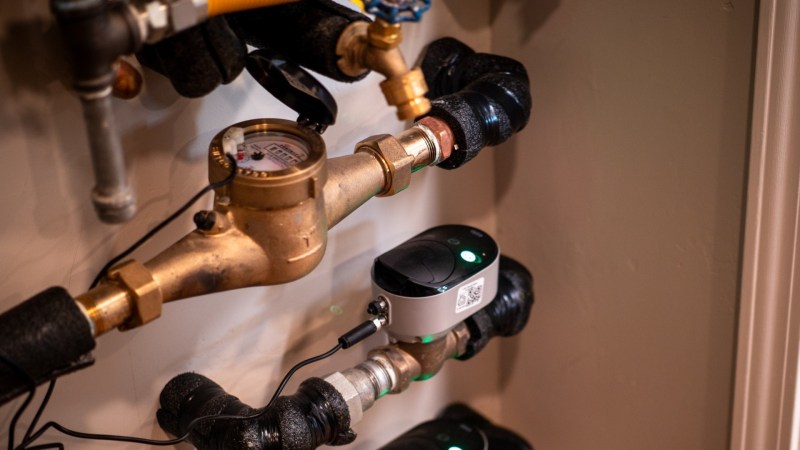
To track water consumption, the system includes a main shutoff valve and smart water meter that belongs to the homeowner, not the utility. By streaming data from the meter, homeowners and builders can track total water consumption. McCarthy says that the meter should stop moving every day, and if it doesn’t, there’s a leak.
“If it’s a major leak, the system can automatically shut off the water. If it’s a small leak, we still detect it. Those are often the leaks that really hurt builders. Small leaks can go undetected for weeks or months, sometimes under a slab or inside a wall, and lead to major damage. This gives us insight into issues before they become catastrophic,” he adds.
Scaling Data
Branded as Abrazo Intelligence in Abrazo homes and offered as a white-labeled solution to other builders, the system acts as a diagnostic “operating system” for the home. Currently, McCarthy’s team has roughly 140 homes on the system so far and has shipped to seven other builders. From a dashboard, McCarthy can see insights into water flow, power consumption, air quality sensors, switches, and thermostats.
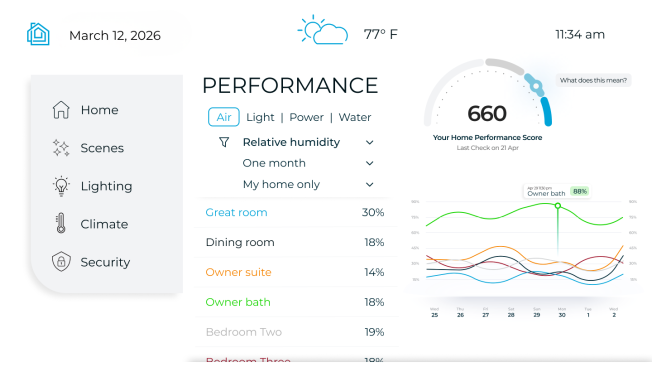
“Under the performance view, we can track how the home is actually operating. We chart indoor temperature against outdoor weather. High-performance homes show very little temperature fluctuation, and that’s comfort, visualized,” he says. “We also track carbon dioxide. With today’s tight energy codes, homes are almost airtight. Without proper airflow management, CO₂ levels can rise, which affects sleep quality and overall well-being.”
McCarthy believes performance data will ultimately help builders prove the value of new construction by showing homes that are more efficient, more comfortable, and healthier to live in. He also believes this data can lay the groundwork for further innovations into virtual power plants, aging-in-place solutions, and AI-driven home management. However, it must be simple to use.
“If grandparents can’t turn off the lights, the system fails. Simplicity drives adoption. Adoption drives better data. Better data drives better insights for both homeowners and builders,” McCarthy says.