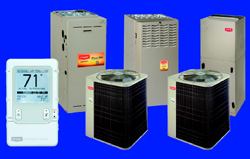
LAST MONTH, THE DREES CO. hit Cincinnati with an advertising campaign announcing that every new home it builds will get a state-of-the-art heating and cooling system. Drees is partnering with Indianapolis-based Bryant Heating and Cooling to install the Evolution system that the manufacturer introduced earlier this year. By adopting higher-efficiency components controlled by a single display unit, the builder aims to add teeth to its Drees Smart logo and show that it is the most energy-savvy production builder in the area.
Cost-cutting is an important profit strategy for many builders. But heating and cooling is one area where the Drees Co., of Fort Mitchell, Ky., says it pays to invest in a better product—in this case, up to 10 percent more.
“We’ve made our niche here by being a builder who takes the time to do these different kinds of energy techniques that will benefit the homeowner,” says Joe Halpin, corporate purchasing manager for Drees. “So much of it is behind the walls where people don’t see it, so we’ve built our whole marketing campaign around our homes’ energy performance.”
Although the Drees Co. builds in nine cities, the rollout is limited to Cincinnati, where it has a 76-year history. With an average price of $320,000, its homes target move-up buyers. “We’re expecting the HVAC system to increase our competitive edge,” Halpin says. “The bottom line is that people are willing to spend more money to buy a Drees home because they feel they’re getting a more efficient product that will hold its value and save them money in the long run.”
The Variable Marketplace That strategy may not work as well in lower-income markets. David Price is operations manager for St. Peters, Mo.-based Whittaker Homes, whose prices average $185,000. He says home technology such as high-speed Internet access trumps incremental heating and cooling upgrades unless the improvement is palpable. For example, buyers are passing on more efficient air conditioners at $500 a pop. Most HVAC upgrades occur in 3,000-square-foot homes, where buyers shell out $4,000 for an additional heating and cooling system. “It’s not necessarily more efficient, but it offers better climate control by distributing air more evenly upstairs and downstairs,” Price says. And although there’s scant demand for air filtering systems, he says he believes they’re the next frontier as an antidote to allergy and mold concerns.
“People are more concerned about a higher SEER than about having 410A,” says Dick Rydzeski, director of national builder sales at Goodman Manufacturing in Houston. “Everyone has the better coolant available, but it represents less than 5 percent of total air conditioning market share.”
Indeed, in a 2003 survey by the NAHB, only 17 percent of home buyers said they would pay more for an environmentally friendly home. Forty-five percent said they wanted such features but wouldn’t pay extra for them. Still, it’s a feature that many upper-end buyers simply expect. Last year, Arthur Rutenberg Homes, a franchise of builders based in Clearwater, Fla., began paying a little more to install R-410A products as standard in its homes, which average $500,000 plus the lot cost. “We’re in a luxury market where a lot of customers recognize the value in that,” says Ed Brown, vice president of purchasing. “It’s not the cheapest thing.” However, he says his buyers struggle with the cost/benefit ratio of upgrading to 14- and 16-SEER air conditioners, paying more attention to gadgets such as variable-speed air handlers, air cleaners, and programmable thermostats.
Old Is Out, Ozone Is In The builder incentive for specing R-410A-based systems will increase as we get closer to 2010, the EPA-mandated deadline by which all new cooling equipment must be Freon-free. “If someone is buying a house with a 30-year mortgage, they should be moving toward the new refrigerant,” says David Meyers, vice president of strategic accounts for Carrier Corp. and Bryant. “An air conditioner lasts 15 years, so from a homeowner’s perspective, we think they would choose the more efficient Puron-based products.” (Puron is Carrier’s trademark name for R-410A.)
But will the R-22 phase-out affect its supply for servicing the old systems? Probably not, says Ed Dooley, vice president of communications for the Air-Conditioning and Refrigeration Institute in Arlington, Va. “R-22 as a service refrigerant will be manufactured until 2020,” he says. “And under EPA regulations, the refrigerant must be recovered, not emitted. Reclaimers will take the coolant and reconstitute it to meet the standard of purity for reuse.”
With such industry changes afoot, builders are weighing HVAC components for their costs and their down-the-road value to customers. Market conditions will determine whether they’ll offer a code-compliant box that blows hot or cold air, or something more sophisticated. For Drees, a high-tech system is a no-brainer, at least in its Cincinnati market. “We’re talking about a savings of $2,000 to $4,000 a year, so payback comes quickly for our buyers,” Halpin says. “It puts us at another plateau where nobody else will be.”
HVAC standards:
Most common options: