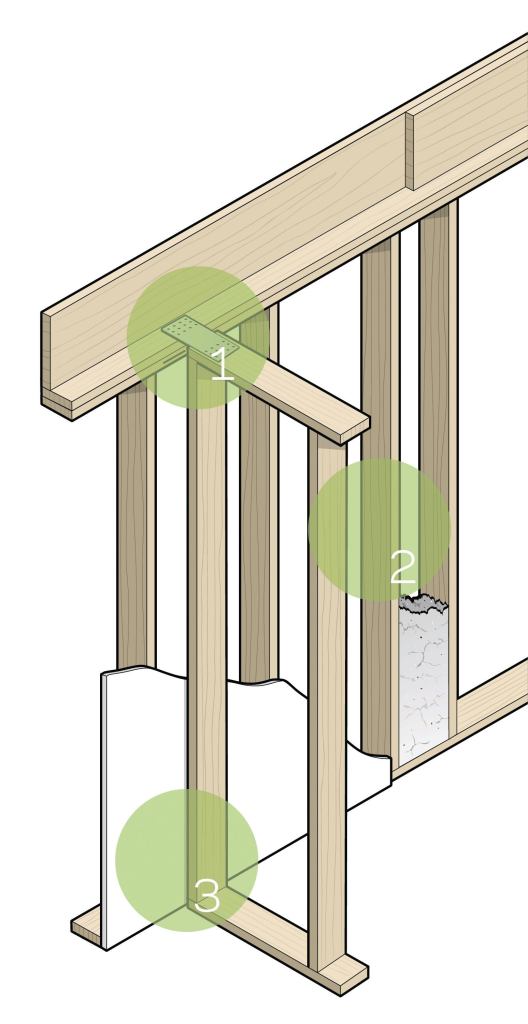
The NAHB Research Center has amended and extended advanced framing practices to further improve building envelope performance, including a new technique that reduces thermal bridging at the intersection of exterior and interior walls.
This technique reduces thermal bridging
1 Continuous Drywall To allow full sheets of wallboard along perimeter walls, mitigating air leaks and thermal transfer, leave a 1-inch gap between intersecting interior walls. Connect the intersecting top plates with a flat metal connector.
2 Wall Framing 2×6 studs spaced 24 inches on-center create larger cavities for insulation to reduce thermal transfer throught the wall and enable “warm” corners without affecting the attachment of drywall or exterior cladding
3 Lower Ratio Typical wall framing has a wood-to-insulation ratio of about 25 percent. Advanced framing reduces that share to 16 percent to 18 percent, leaving more room for insulation and improved energy performance.