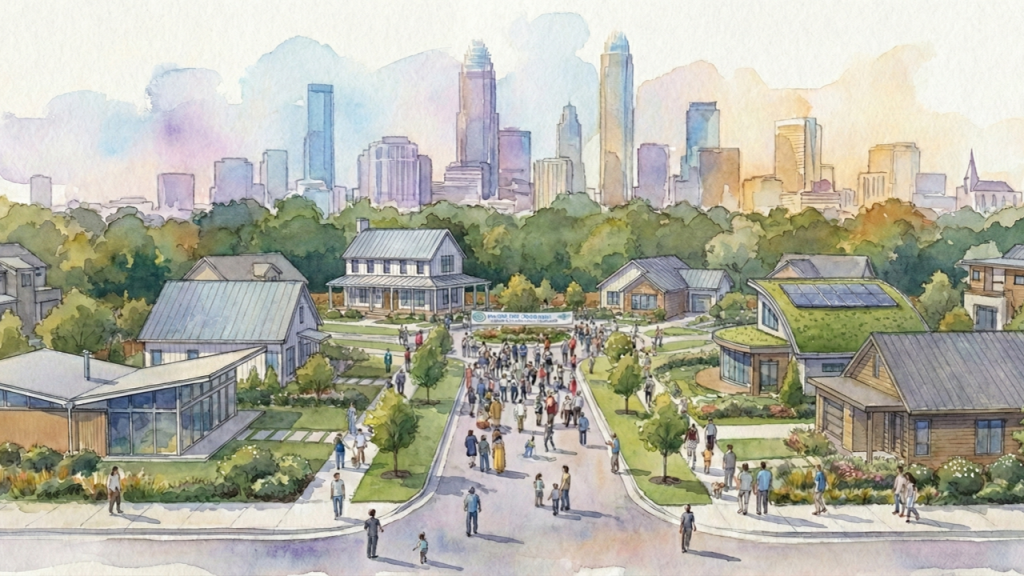
The Housing Innovation Challenge, a national design-build competition partnering students, builders, and innovators to deliver attainable housing solutions, has revealed its inaugural cohort of 20 academic teams from across the country.
Teams will compete for an opportunity to advance to a physical build and public exhibition in Charlotte, North Carolina, in October 2027. Structured as five two-year cycles hosted in different U.S. cities, the challenge is designed to compound learning and accelerate adoption of innovations that reduce housing costs.
Created by partners Housing Innovation Alliance, Meritage Homes, and Home Technology Ventures, with the city of Charlotte serving as the inaugural host city, the challenge pairs student-led design and engineering with real-world constraints, measurable performance outcomes, and industry collaboration to address affordability and accelerate housing solutions that can scale beyond a single project or city.
“Communities across the nation are wrestling with the rising cost of housing, so we created the Housing Innovation Challenge to help generate more solutions that go beyond a theoretical exercise and become part of our physical neighborhoods,” says Dennis Steigerwalt, president of the Housing Innovation Alliance. “What makes this different is the coalition of universities, builders, and industry partners working on the same problem with the same constraints. We’re testing ideas that can actually be built, repeated, and improved, not just admired on paper.”
The 20 academic teams represent a cross-section of disciplines and regions, uniting students and faculty focused on architectural design, construction innovation, building performance, materials, and market viability to help reduce the total cost of housing.
Competing teams include:
- Appalachian State University + University of North Carolina at Chapel Hill + North Carolina State University
- Auburn University
- Brigham Young University
- University of California, Riverside
- Central Piedmont Community College – Honors Program
- Clemson University – College of Architecture, Art and Construction
- University of the District of Columbia
- University of Florida – Sustainability and the Built Environment
- Georgia Tech
- Harvard – Graduate School of Design
- University of Houston
- Kean University – School of Public Architecture
- Michigan State University + Ferris State University
- University of North Carolina at Charlotte
- Pennsylvania State University
- University of Texas at Austin
- University of Virginia – School of Architecture
- Virginia Tech
- Washington State University
- Willamette University
“Universities are where the next generation of builders, designers, and problem-solvers are being trained,” says Bobby Vance, competition director and assistant professor at Virginia Tech. “Students are living the consequences of today’s housing costs. Bringing them into the solution, side by side with industry, creates a pipeline of leaders who understand innovation and attainability pressures firsthand.”
The Process
Each team will submit design proposals by March 20 outlining how its solution reduces the total cost of housing. The proposals will be reviewed by a panel comprised of representatives from the founding partners, and national academic and industry experts.
Up to 10 finalist teams will be announced on May 20 during the 19th anniversary of the Housing Innovation Summit. At that point, the challenge shifts from concept to construction. Finalists will work alongside home builders and industry partners to translate their schematic designs into full-scale homes built in Charlotte, using industrialized and off-site construction methods where possible.
“The Housing Innovation Challenge is the first coordinated competition to unite every link in the value chain around a shared goal: lowering housing costs,” says Vance. “This is proof in practice. We can de-risk new approaches by testing them with industry partners who know how homes get delivered at scale.”
With each cycle lasting two years, the challenge is structured as an open learning platform that can compound lessons from previous cycles. The first cycle will conclude October 2027 with a public exhibition in Charlotte where the homes will serve as living laboratories. When the challenge concludes, each home is intended to be offered for sale to residents.
“The city of Charlotte, with strong leadership from Mayor Vi Lyles, is setting a national benchmark by demonstrating what’s possible when a city leans in,” says Steigerwalt. “This is a sensational debut, but we’re far from the finish line. The Housing Innovation Challenge is a long-horizon platform where each cycle improves the next. Cities, universities, builders, and manufacturers nationwide should be able to see themselves in this effort. The challenge is an open invitation to bring forward what works and to scale what proves itself.”