
Buoyed by the positive momentum from the recent passage of the 21st Century ROAD to Housing Act, industry stakeholders gathered in Washington, D.C., at the National Housing Supply Summit to discuss the solutions, innovations, and real-world examples shaping the housing supply landscape.
While the inaugural event in 2025 was framed around the question of what the federal government can do to increase supply, the sophomore event framed programming around how market and policy innovations across the value chain are leading to increased housing supply.
While recognizing the attention housing has received on a national level has provided momentum for federal policy reform, conversations and sessions centered on the tenet that housing is local. Panelists shared tangible solutions and highlighted how innovation can drive efficiency across zoning, codes, financing, technology, design, and workforce development.
Below are nine takeaways from the event.
Affordability Is Fundamentally a Supply Issue
From the first to the final session of the Summit, a prevailing theme was the relationship between affordability and supply. Zillow chief economist Mischa Fisher outlined the relationship while noting that in areas with fewer building restrictions, more affordable housing has been able to be brought to the market.
NAHB chief advocacy officer Ken Wingert shared that regulatory costs often account for between 20% and 40% of construction costs, hindering the production of housing and contributing to the affordability challenges common in the current housing market. From simple solutions such as developing smaller lots, smaller product, and more diverse housing types to more innovative and unique opportunities such as rethinking the definition of ownership and creative financing options, the panelists during the Summit shared how innovation can lower build costs, add more housing units, and more efficiently utilize housing units already in the pipeline.
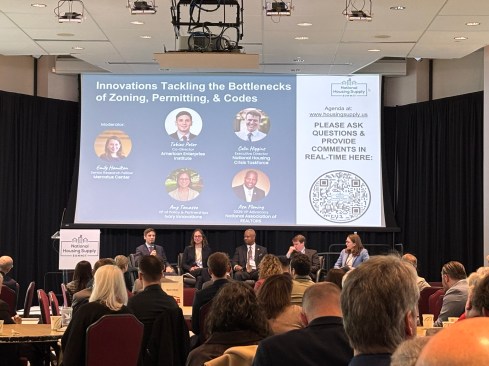
Tobias Peter, Amy Tomasso, Asa Fleming, Colin Higgins, and Emily Hamilton at the 2026 National Housing Supply Summit.
Smaller Lots: More Affordability, More Supply
One of the clearest, high-level ideas to emerge from a session focused on zoning, permitting, and code bottlenecks was simple: allow smaller lots. Panelists from Ivory Innovations, American Enterprise Institute, the National Association of Realtors, and the National Housing Crisis Taskforce pointed to lot size reform as a high-impact lever that directly reduces costs while unlocking meaningful supply gains. Shrinking lots lowers land costs and enables smaller, more attainable homes to be built in tandem.
In one example provided by Tobias Peter of American Enterprise Institute, reducing lot sizes by roughly 40% translated into home prices that were 26% lower, demonstrating a direct link between land use policy and affordability outcomes. Taking a national perspective, allowing smaller lots more widely across the country over the past two decades could have allowed the production of millions more homes. This impact is significant considering the scope of the housing shortage, estimated to be greater than three million units.
“Since 2000, the country, collectively, has been building 12 million single-family homes and the average lot size has been about 8,000 square feet,” Peter said. “If we were to go back and change that lot size to 5,000 square feet, we would have 9 million more homes. So, we wouldn’t be talking about a housing shortage today if we had allowed small lot sizes.”
Design Standardization as a Bottleneck Solution
Panelists during the zoning, code, and permitting session emphasized that the process of getting housing approved can be significantly disruptive to timelines and costs. Design standardization, such as pre-approved plans, standard frameworks, and pattern books, were highlighted as practical tools to accelerate production by removing friction from the entitlement process.
If every project must navigate a bespoke approval process, timelines stretch, costs rise, and fewer homes can be built. Standardization flips that dynamic by front-loading community input and aligning expectations early. A more predictable path from concept to construction can translate to cost and efficiency advantages to help deliver more affordable housing.
There Are No One-Size-Fits-All Solutions
While the backdrop of the passage of a federal housing package provided optimism for housing solutions, the panelists throughout the day reiterated that housing solutions must be tailored to local conditions.
While the housing shortage is national in scale, many of the causes and fixes are deeply local issues. Policies that succeed in one market may fail to gain traction or fall flat in other parts of the country. Amy Tomasso of Ivory Innovations shared the refrain “If you’ve seen one village, you’ve only seen one village” to highlight how even seemingly universal ideas like reducing parking minimums must be adapted to local realties.
“Supply constraints are shaped by local barriers, and therefore require locally-led solutions,” Asa Fleming of the National Association of Realtors.
Data Is the Key to Technology Efficiencies
The National Housing Supply Summit’s focus on innovation naturally lent itself to conversations around AI and technology. A more subtle theme that emerged from these conversations is the importance of good data. Solutions that can help solve for pain points or automate arduous tasks are only as good as the data used to build them. Data that is biased or incomplete can lead to incomplete or biased solutions. As a result, improving systems and housing outcomes is not just about faster processes, it also requires transparent and complete data systems to inform them.
“If we treat [biased] data as neutral, then we can encode that biased into future tools,” moderator Ruby Bolaria shared during a session highlighting technology solutions related to zoning, permitting, and site selection.
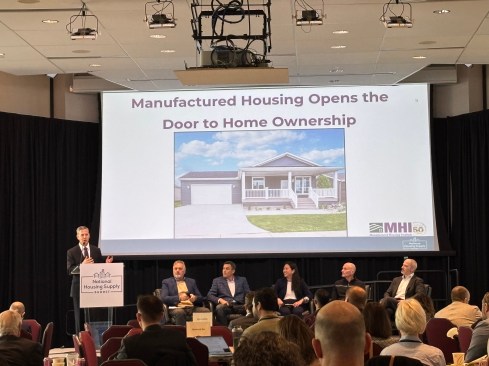
Matt Hoffman, Jim Heid, Lance Manlove, Jenna Louie, Steve Glenn, and Dennis Michaud at the 2026 National Housing Supply Summit
Offsite Practices Are Flexible Tools
During a session focused on innovations in construction practices, Jenna Louie of Villa Homes provided the recontextualization that offsite, modular, and manufactured housing should not be boxed into narrow product categories. The reframing was shared to push back on the common perception that modular or manufactured housing is limited to certain aesthetics of segments.
Instead, Louie highlighted how each are methods of building and tools that can be applied across a wide range of housing types, from single-family homes to multifamily and infill development. In practice, these approaches are already being deployed across diverse use cases from ADUs and starter homes to large community developments to hybrid offsite-onsite applications.
“You can build whatever you like using new building methods as a typology. It’s not ‘manufactured housing is for X and modular is for Y,’” Louie said. “These methods are flexible and you want to be smart depending on your objective in picking the right one for what you are trying to accomplish.”
Several panelists highlighted this flexibility in sharing hybrid use cases, combining factory-built components with on-site construction to optimize cost and efficiency. Lance Manlove of Schell Brothers shared the company’s utilization of panelized components or plans printed onto subflooring help with efficiencies and have reduced cycle times by approximately 25 days.
Confusion, Regulation Contribute to Limited Offsite Adoption
While the promise of offsite construction is well established with faster timelines, greater cost control, and reduced waste, adoption is still constrained in the United States relative to international markets. Panelists highlighted that many of the challenges have less to do with the factories themselves and more to do with everything around it.
“Where we see slowdown and where we see offsite not meeting its promise of speed is primarily on the permitting and zoning processes, not the actual factory,” said Dennis Michaud of CertainTeed.
Inconsistent rules across jurisdictions have made it difficult to scale manufacturing efficiently. Additionally, financing gaps have slowed to adapt to manufactured housing, as many interested buyers do not have an easy way to access financing manufactured homes.
Steve Glenn of Plant Prefab also noted that economics have played a role in the slow adoption of offsite and manufactured housing. For years, traditional site-built housing has remained cheaper in many U.S. markets, reducing the urgency to innovate. However, he noted the equation is beginning to shift as land, labor, and material costs are rising.
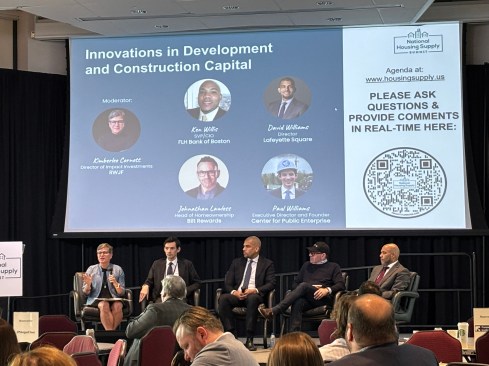
Kimberlee Cornett, Paul Williams, David Williams, Jonathan Lawless, and Ken Willis at the 2026 National Housing Supply Summit
Financing Systems Are Mismatched, Not Broken
Rather than calling for more capital, panelists during a capital session emphasizes a core challenge is how capital is structured and deployed.
Historically, the U.S. has demonstrated the ability to scale housing when financing tools are intentionally designed to support it. The current need is less about new subsidies and more about modernizing delivery mechanisms to provide flexible, lower-cost, long-term capital. Many existing tools remain fragmented or underutilized while emerging potential opportunities like small-scale infill development face barriers due to a lack of standardized, repeatable models.
Jonathan Lawless of Bilt Rewards noted “you cannot finance a snowflake.” Without consistently and scalability, high-potential supply channels such as consumer-led infill remain difficult to unlock at scale.
Rethink What Ownership Looks Like
A recurring theme during a conversation with Brian Elbojen of Jubilee Homes, Tamara Knox of Frolic, Atticus Leblanc of PadSplit, and Dan McPheeters of Point Digital Finance was that expanding housing supply may require rethinking how we think about homeownership.
The panelists suggested traditional, all-or-nothing ownership models can limit access for middle- to low-income households and constrain innovation. The four panelists presented a range of emerging models aiming to lower barriers to entry while making more efficient use of the existing housing stock.
The approaches include separating land and home ownership to reduce upfront costs, shared equity models that expand purchasing power without increasing monthly payments, and co-op or co-living arrangements that broaden access to homeownership and better utilize underused space.