The bright line is in the sand.
The Republican leadership has offered a tax reform plan to cut business, individual, and estate taxes by $1.472 trillion, that it says is a grand bargain to transform the code to a degree not seen in more than three decades.
It’s a grand bargain, however, that plays havoc with assumptions and theories on how its math and economics work out. Broadly, it promises near-term gratification, and, in reality, it thinly conceals profound, long-haul pain.
Specifically, the grand bargain–essentially an attempt to align as many of the nation’s most powerful individual and corporate interest groups as possible under one umbrella of gain–attacks a fundamental building block of community development and strength: Homeownership.
The Tax Cuts and Jobs Act proposes to cut the mortgage interest deduction in half from $1 million to $500,000, double the standard deduction, and cut the capital gains exemption, impacting how often homeowners can deduct profits from a home sale.
The narrative of the proposed GOP tax plan is that it will unleash economic growth by unencumbering companies and individuals with money to funnel less of it to Uncle Sam and more of it into the economy. Wall Street Journal staffer Richard Rubin writes:
To partly offset that lost revenue from rate cuts, Republicans plan to curtail the deductions individuals take for state and local tax payments and mortgage interest and the ones businesses get for the interest they pay on debt. The proposal also repeals personal exemptions, which filers take based on family size to reduce their taxable income.
That combination creates winners and losers, and people and businesses whose tax bills might rise began mobilizing to block or alter the bill.
The Twitter-based marketing strategy to sell in the GOP-backed reform legislation will follow a simple formula. Divide and conquer.
When it comes to the mortgage interest deduction, there won’t be winners and losers. There will be losers and bigger losers. Namely, people who work for and aspire to homeownership, and people whose livelihoods depend on developing and building and selling homes and communities. The National Association of Home Builders illustrates the impact that capping the mortgage interest deduction to loan amounts of less than $500,000 will have here, noting that if the GOP becomes effective as is, the number of Americans using MID will shrink from 34 million to 10 million.
Granger MacDonald, chairman of the NAHB, says the bill “slams the middle class,” and small business. He writes:
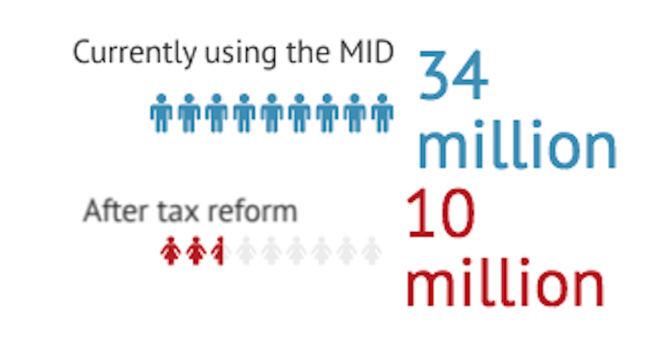
“The House Republican tax reform plan abandons middle-class taxpayers in favor of high-income Americans and wealthy corporations. The bill eviscerates existing housing tax benefits by drastically reducing the number of home owners who can take advantage of mortgage interest and property tax incentives.
“And capping mortgage interest at $500,000 for new home purchases means that home buyers in expensive markets will effectively lose this housing tax benefit moving forward.”
Zillow chief economist Svenja Gudell observes how the bill, in its current form, would set Americans’ interests at odds with one another, further polarizing an already divided populace:
For many Americans struggling with high housing costs and for young adults paying high rents and dreaming of buying their first home, this could be something of a reprieve. By capping deductions for mortgage interest and property taxes, the proposals would reduce the ways higher income taxpayers can limit their tax bill. In particular, higher-income homeowners in high cost/high tax states could see their tax bill go up. Writing specific numeric thresholds into law –as the proposal does with the mortgage interest and property tax deductions – means the value of these deductions will erode over time as home values increase.
The politcal strategy is simple and consistent from Day One. Divide and conquer.
“Contrary to their assertions, the Republicans are picking winners and losers,” Jerry Howard, the chief executive of the National Association of Homebuilders, said in an interview. “They are picking rich Americans and corporations over small businesses and the middle class.”
Both for the American would-be homeowners, for whom that threshold of accomplishment and achievement has been a meaningful source of motivation, and for the people whose livelihoods–builders, developers, trades, real estate agents, and the many, many businesses who support and benefit from them–we believe that this plan can be fundamentally improved.
We’ll stay tuned. But meanwhile, what do you think?