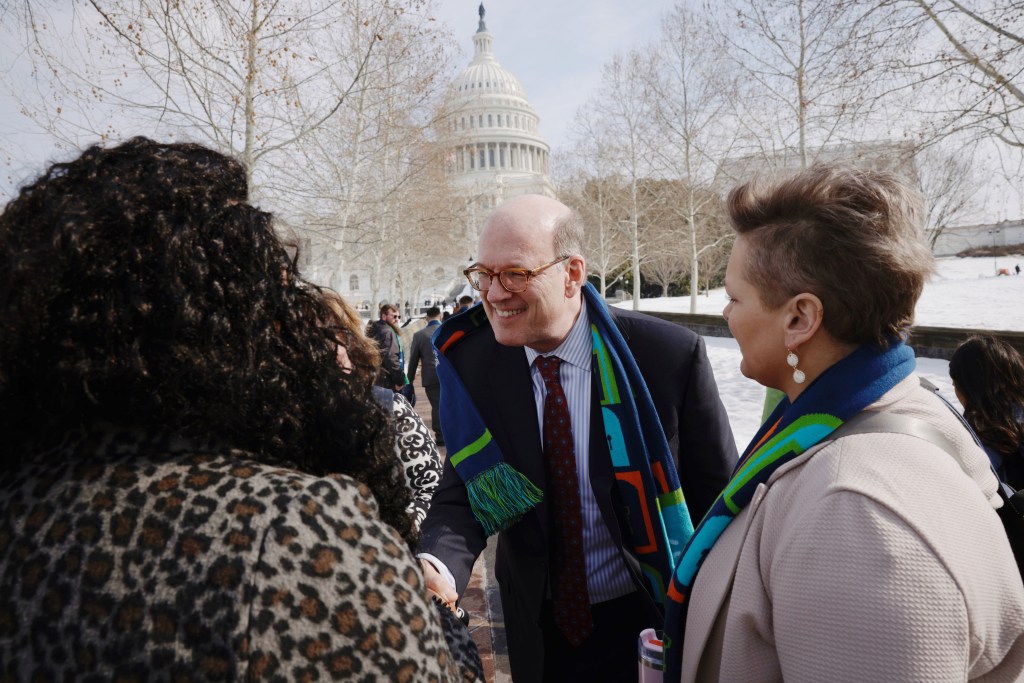
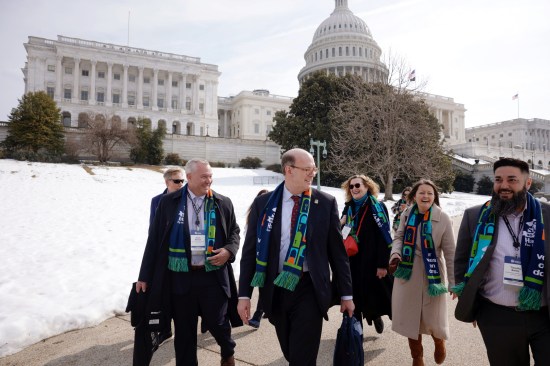
Nearly 500 Habitat for Humanity leaders, students, and advocates descended on Capital Hill in Washington, D.C., to discuss housing policy with policymakers. Housing has emerged as one of the most important issues for legislators, with bipartisan support for efforts to improve housing affordability, remove zoning restrictions, and increase housing supply.
The 20th annual Habitat on the Hill advocacy effort coincided with the House of Representatives’ near-unanimous passage of the Housing for the 21st Century Act, which includes provisions to improve affordability and reduce construction timelines. While the passage is a positive sign of bipartisan support for housing reform, advocates hope for additional policies to support the expansion of affordable starter home supply to address the ongoing housing crisis.
Ahead of the Habitat on the Hill efforts, Habitat for Humanity International—No. 28 on the 2025 Builder 100—CEO Jonathan Reckford spoke with BUILDER about the evolution of Habitat’s advocacy efforts, the bills being discussed in the legislative cycle, and the significance of housing being a top legislative priority.
What is the significance of Habitat on the Hill being in its 20th year?
I was reflecting with our head of government relations and advocacy that 20 years ago there was a debate about if we should do advocacy. As we looked at the scale of need, it became so clear that we could never build our way out of the problem. We changed our framing question from “how many houses can we build?” to “what would it actually take to address the housing need?” in all the geographies we serve around the world. That forced us to think about markets and systems and how we could be a partner and catalyst for worldwide access to safe, decent, affordable housing.
The final count was 467 Habitat leaders, buyers, board chairs, and students here [in D.C.]. It’s potentially the most consequential of all of the 20 Habitat on the Hills in terms of the degree to which housing is on the agenda right now.
Housing received a lot of attention during the election and remains a prominent topic for legislators on both sides of the aisle. What does this say about the state of housing and the significance of the advocacy work being done this year?
The bad news is the reason everyone is talking about housing is because the crisis is so bad. If we can bring good out of that, hopefully we can turn that into action. The gap between what it costs a developer to build a unit of housing and what a family can afford is the widest it has been in modern times. We are the friendliest developer you will ever meet and we cannot build a unit of housing that a family at 50% to 80% of median area income can afford to rent or buy without some kind of subsidy. It’s a collective issue of how we get the public sector, the private sector, and civil society working together to solve the math and dramatically increase supply.
We’ve had an affordability challenge for a long, long time. Now that middle-class family’s children cannot afford the housing in the communities in which they grew up, it has become a national political issue. We already had an affordability and attainability challenge. But now it is a political issue. Because of that, in the House and the Senate, we’ve got significant housing bills moving. The House almost unanimously passed the Housing for the 21st Century Act and the Senate has strong bipartisan support for the ROAD to Housing Act. We are encouraged. I’ve never seen a time where legislators and the federal, state, and local level see housing as their top priority.
What does it mean to have a group of nearly 500 leaders advocating on behalf of the industry?
A great strength of Habitat is that we are political, not partisan. We serve in nearly 1,000 communities around the country, we are in every congressional district, and we have always worked with anyone who wants to work on housing. We have had high trust with government leaders and with the private sector. We are here this week to support both the House and Senate initiatives and some specific pieces within that. Habitat has a number of priorities that are heavily focused on how we increase the supply of attainable housing. That includes increasing funding and making it faster and easier to build.
We think the HOME Act is one of the most important federal channels for supply. Some of the bipartisan work being done to reform HOME and make it easier to use is important. Similarly, community development block grants are important vehicles for counties and cities to be able to support new development. There are things important to Habitat, like the Self-Help Homeownership Opportunity Program which helps with land and infrastructure for new, affordable homeownership projects or Section 4.
Habitat for Humanity International
Habitat on the Hill is taking place concurrently to the House’s passage of the Housing for the 21st Century Act. What does Habitat for Humanity like about what is included in the House package?
On the Housing for the 21st Century, we were involved in a number of subcomponents. For HUD, the Housing Supply Frameworks Act is bipartisan and focused around best practices for zoning and land use. One of the giant trends is how do we make it faster and easier to build? A lot of zoning rules that were created in the 1980s don’t really make sense anymore, but they are still constraining and increasing the cost and time to get housing done. This would be federal funds and expectations that if counties and cities are getting federal money, they would do zoning reform that would make it easier to have appropriate density in the right places and move away from some things that aren’t needed in some places like parking minimums and minimum large lot sizes.
Another [piece we like] is the Unlocking Housing Supply Through Streamlined and Modernized Reviews Act. This would streamline the environmental reviews. It would not get rid of them, but it would not have them be such a barrier from a time and uncertainty perspective. Another huge piece is for rural housing. We’ve got a huge qualitative and quantitative rural housing challenge. Some reforms in the USDA 502 and 504 programs that would make it easier to use those programs.
Can you talk about the Senate’s ROAD to Housing package that is also being considered?
On the Senate side, there’s also a piece on HOME reform that has some parallels. They have their version of the Housing Supply Framework Act. There is bipartisan agreement on that. The Senate has the Whole-Home Repairs Act; housing preservation is another piece where if we can actually break through and preserve housing for lower-income existing homeowners, that’s an important piece. The Senate has an Innovation Fund [and] a Build More Housing Near Transit Act. We agree the best approach for everyone is mixed-income, mixed-use housing. There is a piece on Community Development Block Grant Disaster Recovery; Congress has spent $100 billion on disaster response but no structured, formalized approach. Those are some of the places we have been most active.
Our view is that you never get perfect, but [ROAD to Housing and Housing for the 21st Century] are the most substantive legislation on housing since 1990.
Are there examples of solutions locally or at the state level that Habitat representatives are looking to highlight during their conversations with legislators?
In our advocacy poster exhibit, we had about 20 examples from different states and countries of innovative success in advocacy. We are seeing states move on making it faster and easier to build. Texas, Montana, and a number of other states have done legislation to get rid of minimum lot sizes, parking minimums, and some other things that were getting in the way of moving faster on supply if there is an affordability component. Accessory dwelling units (ADUs) are a good example of a way to get soft density and increased supply in communities of opportunity and help with the mismatch. We’ve got a bigger supply challenge of units than we do on square footage. We have a lot of baby boomers living in huge amounts of square footage that they no longer need but they want to stay in their communities. This is where building ADUs may allow a single woman living in her family’s historic house to move into an ADU and rent out the house to a family and keep it in her family as an asset but create a better portion of housing for that square footage for housing. That’s been very successful in a number of cities. There’s no magic bullet. It’s an all-of-the-above approach. We are seeing zoning changes are enormously important. We are seeing it is about land and financing. Colorado has a new housing finance approach that is incredibly helpful as well as a new movement on a housing trust fund. If you went state by state, there are quite a number of pieces. In Atlanta, the mayor has said if you bring an affordable or mixed-income project, they will fast track all your permits and entitlements. That doesn’t cost the city, but it is valuable for a builder and developer. It’s thinking about the demand side and the supply side. We do need demand side help, but if we do it without fixing supply, we are going to continue to push up prices.
Can you talk about the Homeownership Supply Accelerator? What does it encompass and what has the progress been on this initiative for Habitat for Humanity?
As soon as we get the ROAD to Housing passed, we want everyone to focus on the Accelerator. What we are hearing is that it should be sequential. But this goes to the point I just made which is that fundamentally the supply gap is at the entry-level market. What we don’t have are starter homes. This would be a federal accelerator that would give financial incentives for building new starter homes for low- and moderate-income families. Utah is an example where they have put in a big accelerator for creating new starter homes. For us, that is a big priority because it addresses the supply gap.
With housing reform being such a prominent topic with bipartisan support, what is the level of optimism that there will be movement toward actionable solutions?
I am feeling that optimism. We wouldn’t do this work if we weren’t optimistic at heart. Our vision 50 years ago was a world where everyone has a decent place to live. I can’t think of a time in my 20 years where everywhere I talk people are leaning in and saying we have to do something. I do think it is because it has gotten so bad. I do think there is motivation on both sides of the aisle. Motivation for both urban and rural folks, motivation at the local, state, and federal level. Hopefully we can create some movement. These federal bills would not be sufficient, but they would be an important step. If you combine that with state and local efforts, you could move the needle on supply.

Habitat for Humanity International
What can be done beyond the efforts during Habitat on the Hill to continue to advocate for housing solutions?
There’s a huge education component. Most people in positions of power grew up in good housing. It’s not a visceral understanding. What I said earlier was now that middle-class family’s children are struggling to afford housing, it is becoming a political issue. We already had a widespread affordability challenge. Because of that, people are seeing that. You’ve got young people thinking they will never be able to afford a home. That has political consequences and is creating some urgency at all levels of government. It is going to take everybody. Our view is that the government does not have enough resources to solve this issue, nonprofits alone also certainly don’t. We need public, private, people partnerships. The private sector has to bring serious capital and capabilities to scale. The question is how do we target public subsidy really strategically to get the maximum benefit in terms of turning it into affordable units. People are recognizing that we need to do something different. We often describe it as binary choices, but really it is a continuum of things. We need smart density, that doesn’t mean density in every single neighborhood, that means density along transit and where the jobs are. We need demand subsidies, but it can be very narrowly targeted and help people. We need everybody to focus on how we can increase supply, specifically entry-level homeownership and for low- and moderate-income rental units. The market is providing the upper income and high income units just fine. I do think there is enough urgency that it gets everyone to the table to get very practical about solving some of these things.
If you were to sit in on every meeting with legislators, what would be the message you hope they take away?
On the House side, it would be thank you. But that is the beginning, not the end of the story. Please work with the Senate and actually get this across the line. And it will require funding.
On the Senate side, it would be please pass the ROAD to Housing Act with all the pieces, but also the math doesn’t work. There needs to be funding in there and they need to work with the House to make sure there is both funding and policy reform.
For us, don’t forget about affordable homeownership. When we look at the wealth gap in our country, until you get to quite wealthy people, the wealth gap is explained by people who have had the ability to have those long-term savings over time through homeownership and homeownership has been the best vehicle to move people up into the middle class. Both at the family level and the community level, communities are better off when you have more homeowners.
Don’t make perfect the enemy of good in getting things done. We need action. This is a rare time there is a chance to demonstrate that Congress can work and we can do things in a bipartisan way to solve real problems for people.