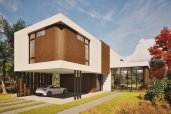
The 4,000-square-foot contemporary will have a structural steel frame for large, open interiors and dramatic cantilevers. Half of the exterior will be clad in zinc—“It has a 100- to 150-year lifespan,” Prutting says—and half in Alaskan yellow cedar. The house will be filled with what Prutting calls “smart, progressive stuff”: photovoltaic panels, maybe a solar hot-water system, engineered quartz floors with radiant heat, a rooftop deck and garden, and items Prutting found at European trade shows. “The philosophy is really to create a state-of-the-art building,” he says. “I’m hoping to build this for $2.5 million, and the retail will be one side or the other of $4 million.”
“The marketplace for this house is very small,” Prutting admits, “but I believe it’s very strong.” And building a house that is one step ahead of the market “solidifies our reputation for being progressive.” Another reason for building this house, Prutting allows, is that he just wished someone would. Despite a growing trend toward in-town living, he notes, the most common approach in his town has been to shoehorn an oversized suburban hulk onto a small in-town lot. “We think [this house] is a classier response to that—less obtrusive, less looming.” And after a career spent building to other people’s tastes, “It’s an opportunity to be expressive as a developer.”
Becoming a developer is design/build architect Clayton Nishikawa’s way to address a problem that has long troubled him: the disappearance of affordable real estate on his home island of Maui. With the median sales price of a house at $700,000, Nishikawa says, “Housing has become a crisis, and the workers are leaving. They can’t afford a house here.” By serving wealthy, relocating mainlanders, Nishikawa has benefited from the island’s growing exclusivity. But his success has given him the tools to help balance the equation. “Past clients have come back with confidence that we could do well with their discretionary income,” says Nishikawa.
Backed by these investors, he is developing some 320 acres of land with a mix of market-rate and sub-market-rate houses. “We’ve got a total of 160 units,” he says. “Ninety-four are going to be affordable,” pegged to the median income of island residents. Under ordinary circumstances, he says, building a house to sell below $300,000 “would be financial suicide.” In this case, however, “Hopefully, we’ll have the market-price homes offset the losses we’ll incur on the affordable units.”
Nishikawa’s motives are not entirely selfless. His development deals are designed to clear a profit. He also has three teenage children, and he would like them to someday be able to afford a home on the island. “If I don’t do something now,” he says, “then I’ll have myself to blame when they’re all living in Las Vegas.” But, such healthy self-interest notwithstanding, he is sticking his neck out for a good cause. “It’s a way of giving back to the community and being a good developer and having good karma and leaving the world a better place.”
Balance your workflow, exercise your creativity, influence the real estate market, and maybe make a buck in the process. Building a spec house every now and then might not be such a bad idea after all.