For most of the past decade, 3D-printed construction has existed somewhere between experimentation and spectacle—provocative demonstrations, one-off homes, and ambitious claims about the future of housing. What’s been missing is a credible path from technical novelty to repeatable, scalable production that works for builders operating in real markets under real constraints. As the housing industry enters 2026 amid continued cost pressure, labor shortages, and margin compression, that gap is beginning to close.
ICON believes it has reached that inflection point.
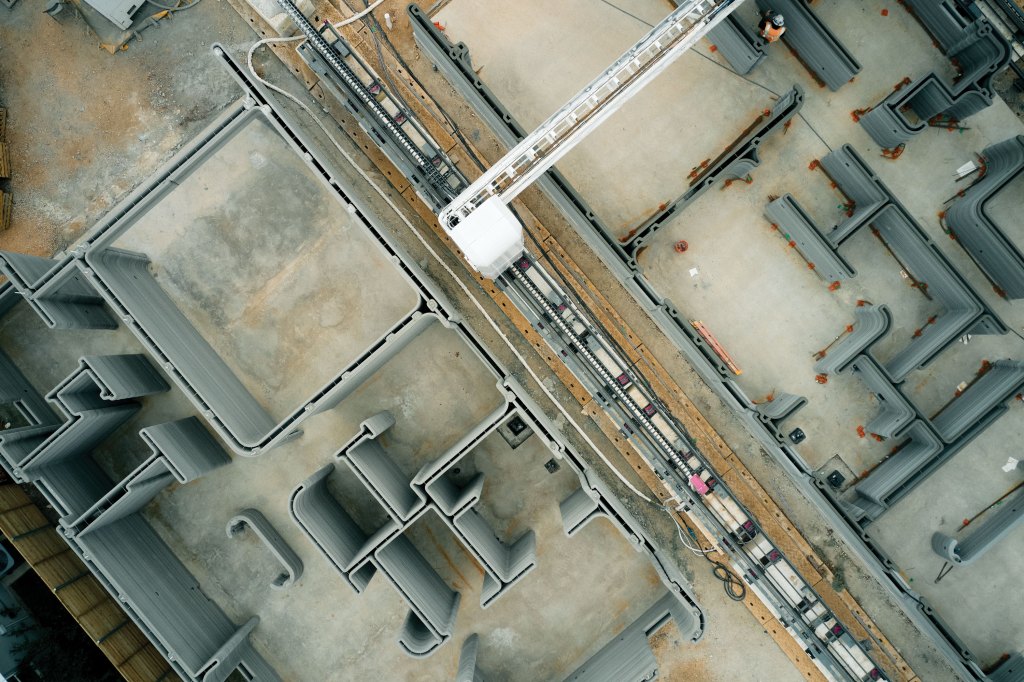
After years of acting as its own developer and builder—absorbing the risk, cost, and operational complexity of deploying construction robotics in live environments—the Austin, Texas–based company is preparing to formally open its platform to outside builders. The shift is driven by the rollout of ICON’s next-generation Titan system, a rail-less, multistory-capable 3D-printing platform designed to deliver reinforced concrete structures with significantly lower labor input and tighter cost control than conventional framing.
But ICON’s ambitions extend beyond hardware. The company is positioning itself as a vertically integrated partner, combining robotics, proprietary material supply, architecture optimized for additive construction, regulatory and permitting support, and on-site field engineering. The goal is to give builders—particularly small and mid-sized operators—the ability to deliver higher-performing homes at lower cost without taking on untested technical risk.
ICON’s CEO Jason Ballard explains why 2026 marks a turning point—not just for the company, but for how housing may be built, scaled, and delivered in the years ahead.
Philip Cheung
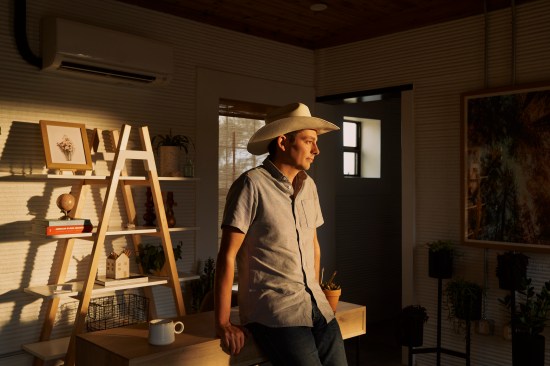
Jason Ballard, co-founder and CEO of ICON, in the welcome center at the Community First! Village.
Let’s jump right to the point. What’s happening in 2026?
In 2026, we’ll lean into big announcements we’ll be making around our newest technology, clear program details, and active outreach. We’ll be on planes and in trucks, visiting potential partners, understanding their businesses, and figuring out how to help. Demand will guide where we go first. We have a rough idea of the likely hotspots, but we also want to be responsive.
Over the next six months, we’re really focused on defining what “ICON-level quality” means. There’s a quality line we won’t cross. Our goal is not simply to do what we do now, faster and cheaper. Our goal is to find a fundamentally better way to build—and then make that better way faster and cheaper.
We’re now far along in testing the Titan architecture. We understand our costs, and in 2026 will begin formally announcing that we’re ready to onboard builder partners into this new way of building. We don’t see this as “sell you a robot and wish you luck.” We see it as: you’re part of the ICON team and family now, and we’re going to support you.
Partners will operate their own robotic systems, and we’ll supply the material. The program is not just about hardware—it’s a complete system they can use.
We also have field engineering. If something breaks on site, a “red team” will show up and get the machine back online—like an F1 pit crew. The idea is that ICON stands behind the system, so builders can focus on running their businesses.
Why can’t you just hand off the machines and let the builders figure it out?
We quickly learned it’s not that simple. You can’t just hand someone a robot and say, “good luck.” We realized we needed to spend a serious amount of time—what turned into about half a decade—acting as the builder ourselves. We had to prove to ourselves and to the market that you could run a construction company profitably with these tools and deliver homes that outperform conventional houses. That’s what we’ve essentially been doing.
And that leads us to the new machine?
That led us to conclude we needed a rail-less system that could pull up and start printing within a few hours—the way a framing crew can just show up and get to work.
We also needed multistory capability. Roughly half of the market is single-story, but urban and suburban density increasingly demands multistory construction. So the next-generation system needed to be rail-less and capable of multistory work.
Then there was reinforcement. In our early systems, the print operator would manually lay rebar into the walls at certain levels. Cutting, preparing, and placing that rebar added another roughly $5 per square foot. To really unlock the benefits of automation, we had to move beyond just printing concrete to printing reinforced concrete—automatically. That required developing an entire subsystem around reinforcement.
Once you pull all those levers, you go from needing three to four operators on site down to one or two. You’re driving labor costs toward zero.
Nick Simonite
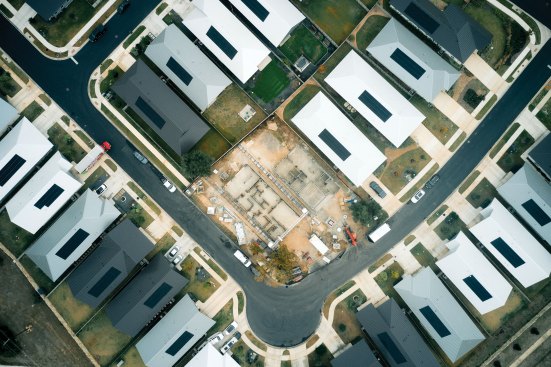
ICON nears completion on its 100-home community in the Wolf Ranch master plan in Georgetown, Texas.
Is there anything else about the new machine worth noting?
A big insight was architecture. One metaphor I like is this: Once upon a time, we built bridges out of wood. When steel was invented, we didn’t just recreate wooden bridges in steel. Steel enabled entirely new types of bridges. Similarly, 3D printing is an entirely new way of building; it doesn’t make sense to just replicate conventional house plans layer by layer in concrete.
In the early days—and still today—many customers say, “Here’s the house I was going to build. Can you just print this?” The answer is yes, but that leaves a lot of the cost-saving and design potential of 3D printing on the table.
That’s why we built an internal architecture and design team. To fully leverage 3D printing, buildings need to be designed for it. You need:
- Robots to automate labor
- Materials engineered and supplied to minimize cost
- Architecture optimized for the technology
Once all three are aligned, you have a system that we believe is the fastest, lowest-cost way to build high-quality housing on the planet. Yes, a tent or a basic trailer might be cheaper, but that’s not the kind of long-term housing solution we’re aiming for.
So what’s your role going to be? Are you still a builder?
Our role is to support a community of builders who will actually lead this revolution. They know what architecture makes sense in New England versus South Florida versus California. As we expand nationally and eventually internationally, their local insight is critical. Our job is to equip them with tools, systems, and support so they can run more powerful, more profitable businesses with higher-quality products.
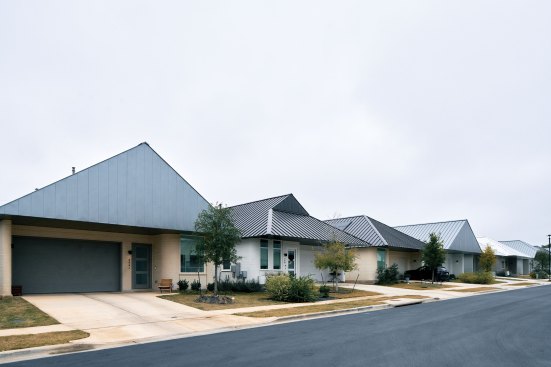
A good example is our project with Lennar at Wolf Ranch, a 100-home community that became Lennar’s No. 1–selling community in Central Texas. Those homes have had the lowest warranty claims of any Lennar community in the region. Their homes sell fast, they experience fewer warranty issues, and they have less trade coordination because they control the means and methods of production with our system. They deliver higher quality at lower cost, and we support them end-to-end.
That’s essentially the shape of the next few years for us with all of the partners we are building projects for. A few of the projects including building 10 additional barracks for the U.S. Army–part of a contract award of $62.8 million; building 100 more homes for the chronically homeless at Community First! Village; the first 3D-printed hotel and development in Marfa, Texas, with Liz Lambert; multiple developments in Austin, Central Texas, Miami, Florida, and more.
Nick Simonite
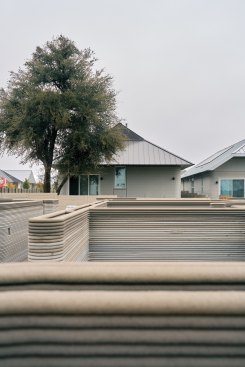
Layers of ICON's proprietary cementitious-based material make up the wall system of each home.
So you won’t be pulling out of the building on your own altogether?
We will continue building ourselves, because that’s how we keep learning and pushing the technology forward. We plan to stay about a year ahead of our network—trying new architectures, new mix formulations, and new robotic subsystems on our own jobs first. Once we’re confident they work, we’ll roll them out to partners. Because we’re a venture-backed technology company, we can shoulder that research and development and deployment risk so our partners don’t have to.
What are you hearing from builders? It’s not like they’ve been able to use the tech?
The builders we’ve spoken with so far are very excited. When we unveiled the Titan engineering prototype in 2024, our main intention was to sell more construction projects for ourselves. Instead, many people came up and said, “How do I get one of these?”
We hadn’t planned for that, but we quickly put together a simple one-pager with a $1,000 reservation option—mostly just to see what would happen. We didn’t have a fully defined program. The paperwork basically said, “This will give you the ability to build at $25 a square foot or less.” That was about it. Even so, dozens and dozens of people put money down with very little information.
So far the response has been very enthusiastic—and importantly, it has been organic.
How much will you grow in 2026 if all goes according to plan?
We expect a huge year for our construction business, even though the broader housing market is in a relatively low cycle by historical standards. We’re on track to grow over 300% next year in essentially every metric—revenue, homes built, and so on. Interestingly, the value of what we’re doing becomes even more obvious in a down market. Every nickel matters. A differentiated product with better performance and quality matters even more when there’s an oversupply of undifferentiated homes.
Right now, there’s almost no perceived difference between the top large production builders in terms of quality, performance, or architecture. In that environment, something genuinely different and better can stand out. As interest rates shift over time and the market cycles, we believe a compelling value proposition on quality, cost, energy efficiency, and aesthetics will win across cycles.
Once we see demand for six to 10 printers in a single market, that market becomes a candidate for a full “market opening.” That’s where we’d deploy a batch plant and support infrastructure so our partners can ramp quickly and succeed from their first projects.
How would that work?
We’re not trying to become one of the top 100 builders by units. What’s unique about ICON is that we see this as the fastest-growing channel of new-home construction. As a network, our partners together will have the scale and influence of a very large builder.
That creates powerful secondary benefits. Because of the collective volume of the ICON network, we can go to suppliers of non-printed elements—paint, finishes, windows, doors, roofing—and negotiate pricing as if we were a large national builder. That means a builder who currently does 25 to 100 homes a year can suddenly get pricing comparable to what a major builder gets.
Nick Simonite
The 100-home neighborhood in Hillwood Communities' Wolf Ranch was built by Lennar and ICON and co-designed by BIG.
So are you targeting the big builders or small?
Everyone talks about the Builder 100, but I’m very interested in the “Builder 10,000,” or all the small and mid-sized builders who collectively represent the majority of the market. The top large production builders only account for maybe 15% to 20% of total annual volume. Our system helps the big players build faster and cheaper, but I think our strongest value proposition is for those small and mid-sized builders who will suddenly be able to compete toe-to-toe with the largest, most scaled companies in the industry.
Do you see the builder who’s doing 12 spec homes a year switching the way they’ve always built and adopting 3D printing for those 12 homes?
If they want to make more money and deliver a better product, yes—that’s exactly what I expect they’ll want to do.
What about buyers? Are you sure they’re ready for this?
On the consumer side, we were much more worried early on about how buyers would react. What we’ve seen has been very encouraging. Lennar will tell you that Wolf Ranch was one of their top-selling communities in Central Texas. They expected the buyers to be mainly young, tech-oriented early adopters. But if you go there and just watch who’s going in and out of those homes, it’s everyone: retirees, a single guy working at Tesla or The Boring Company, young families, and more.
I do think there’s a natural adoption curve. We’ve moved past the “extreme early adopter” stage into early mainstream. It will still take time, and there will always be people who simply prefer a brick house or a log cabin—and that’s fine.
But for most people, if the home is beautiful, something they’re proud to live in, and they can finally afford it—and if it comes with lower maintenance costs and lower energy bills—the difference in aesthetic becomes a positive, not a barrier.