As Florida continues to anchor itself as one of the nation’s most active new-home construction hubs, a closer look at quick move-in (QMI) inventory offers valuable insight into how builders are positioning product at the community level. As of February, Orlando, Tampa, Sarasota, Jacksonville, and Miami all ranked within the top 20 U.S. markets for housing starts, but the amount of completed homes available per community varies meaningfully across metros.
While QMI strategy varies by builder, with some fully spec builders and others more heavily to-be-built, metro-level QMIs serve as a useful barometer for operational pacing. Further, QMIs per community is a good way to track how new-home supply looks in the context of actively selling projects. Elevated levels can signal confidence in near-term demand or a need to convert standing inventory, while declining levels often reflect tighter construction pipelines or a more measured approach to spec delivery.
Market-Level Trends
- Orlando posted a relatively balanced profile. At 2.42 QMIs per community, the market saw a modest 1% year-over-year decline.
- Tampa stood apart from the rest of the state. With 3.76 QMIs per community, the market posted an 18.5% year-over-year increase, the highest among Florida’s major production metros.
- Sarasota reflected a sharp pullback. QMIs per community fell to 2.49, down 22.1% from a year ago.
- Jacksonville recorded the lowest level among the group at 1.69 QMIs per community, representing a 26.6% year-over-year decline.
- Miami rounded out the list with 1.93 QMIs per community, up 3.9% year over year.
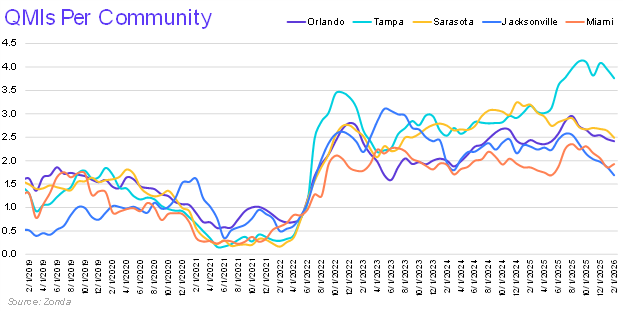
For all top Florida markets, QMIs are down from recent peaks but remain elevated compared to pre-pandemic times. As the state moves through 2026, how quickly these QMIs convert to contracts will be a critical signal of market health and operational efficiency.
The insights in this article were taken from the Zonda Market Ranking published in Zonda’s National Outlook subscription.